
Automatic vs Quartz Watches: The Engineering, Soul, and Truth
Comparing kinetic mechanical escapements against battery-driven quartz oscillators.
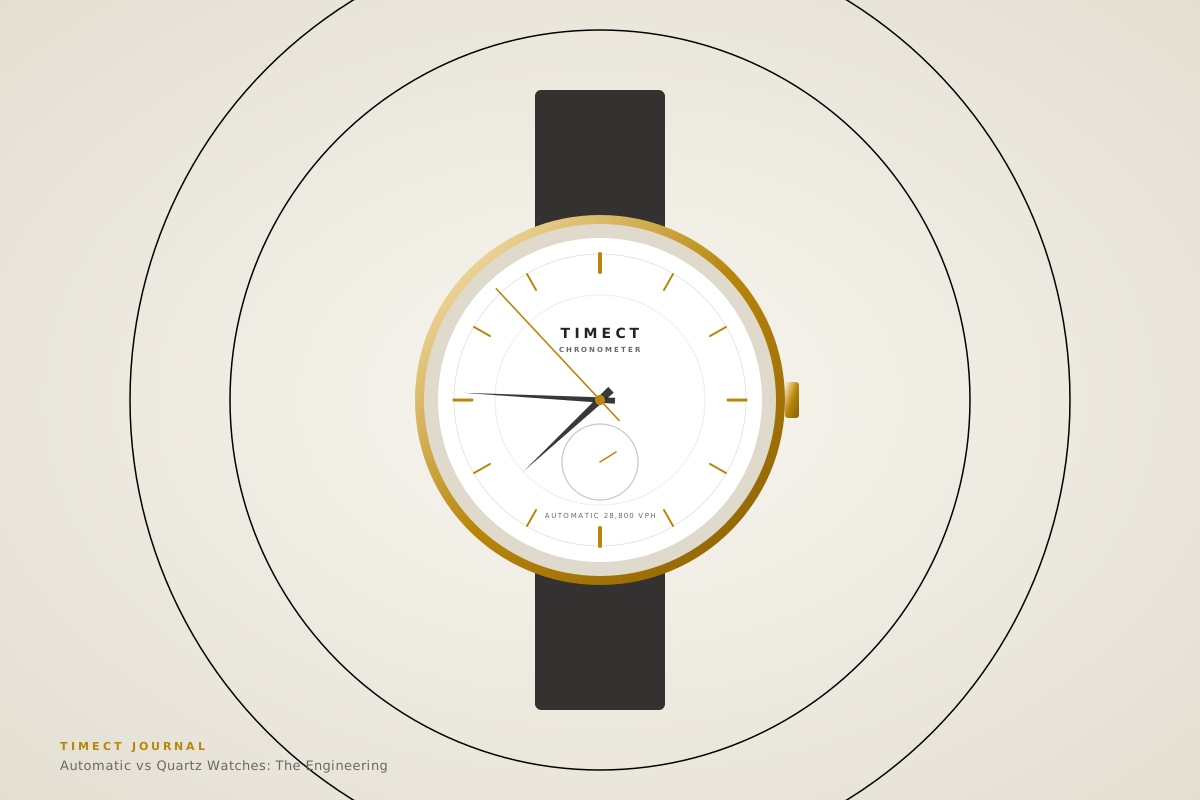
The key difference between automatic and quartz watches is their power source and regulation: automatic watches are mechanical machines powered by a mainspring and regulated by a balance wheel with a sweeping seconds hand, while quartz watches are battery-powered, regulated by an electronic quartz crystal, and tick once per second with superior numerical accuracy.
The difference between automatic and quartz watches is not merely battery versus spring—it is an ideological divide between micro-mechanical soul and electronic quartz oscillation.
Direct Comparison: Mechanics vs Electronics
A quartz watch utilizes a synthetic quartz crystal tuning fork vibrating at 32,768 Hz when stimulated by electrical voltage. A stepping motor translates this into a distinct once-per-second jump. In contrast, an automatic watch uses a coiled mainspring releasing tension through an escapement and balance wheel, producing between 6 and 8 micro-beats every single second.
| Feature | Automatic Watch | Quartz Watch |
|---|---|---|
| Power Source | Kinetic wrist motion / Mainspring | Silver-oxide Battery |
| Seconds Hand Motion | Continuous smooth sweep (6-8 beats/sec) | Single tick per second |
| Accuracy | +/- 5 to 15 seconds per day | +/- 15 seconds per month |
| Service Lifespan | Generations (100+ years repairable) | 15 to 30 years (circuit dependent) |
Why Enthusiasts Cherish Mechanical Calibers
Mechanical calibers represent centuries of horological heritage. Wearing an automatic watch connects you directly to the centuries-old lineage of watchmakers who conquered navigation and astronomical observation using pure gears and springs.
Horological Benchmark Specifications
Engineering Tolerances
Regulated in 3 to 5 positions; isochronism variance limited to +/- 4 to 8 seconds per day.
Material Composition
Austenitic 316L stainless steel, anti-magnetic alloys, synthetic sapphire with internal anti-reflective coating.
Escapement Frequency
28,800 vibrations per hour (4 Hz) or 21,600 vph (3 Hz) providing optimal balance longevity.
Preventative Maintenance Cycle
Pressure testing every 24 months; comprehensive ultrasonic overhaul every 4 to 6 years.
In-Depth Technical Evaluation: Micro-Mechanical Nuances
When assessing automatic vs quartz watches: the engineering, soul, and truth, the true differentiator lies in microscopic finishing and kinetic efficiency. The interaction between the balance hairspring and the pallet fork gems determines whether a timepiece maintains stability over multiple decades. High-grade synthetic rubies (corundum jewels) are polished to minimize frictional drag at pivot points, while synthetic epilame coatings prevent lubricant migration away from the escape wheel teeth.
Curator's Verdict & Acquisition Advice
For both aspiring enthusiasts and seasoned collectors, understanding the architectural pedigree behind this timepiece ensures lasting ownership satisfaction. Rather than chasing transient design trends, invest in pieces characterized by proportional harmony, serviceability of internal components, and transparent manufacturing provenance.
Editor's Summary Note
Horology remains one of the few physical crafts where traditional centuries-old hand finishing merges seamlessly with modern aerospace tolerances. Treat your timepiece with regular care, keep it shielded from high magnetic fields, and it will serve as a multi-generational companion.
Common Questions & Guidance
Is an automatic watch more expensive to maintain?
Yes, an automatic watch requires mechanical overhaul every 4-6 years, whereas a quartz watch usually only requires periodic battery replacements.
Related Articles
View All →
Mechanical & Automatic
Demystifying Power Reserve: How Mainspring Energy is Stored and Delivered
Mechanical & Automatic